The Zone: A Prison Camp Guard's Story by Sergei Dovlatov
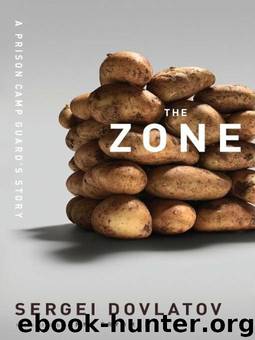
Author:Sergei Dovlatov [Dovlatov, Sergei]
Language: eng
Format: mobi
Tags: Russian, Fiction
ISBN: 9780394535227
Google: 0ArRngEACAAJ
Amazon: 1847491987
Goodreads: 153312
Publisher: Knopf
Published: 1985-01-01T11:00:00+00:00
May 24, 1982. New York
Dear Igor,
I have already said that the zone can be seen as a miniature replica of society. Sports, culture, ideology are all represented. There’s an equivalent of the Communist Party (the Section of Internal Order). The zone includes commanding officers and privates, academics and dunces, millionaires and beggars.
The zone has its equivalent of school, and of career-building and success. Here, life keeps the same proportions in human relations as on the outside.
Correspondence with relatives takes up an enormous part of camp life, even though only some prisoners have relatives. This is a particular problem for criminals serving long sentences. The years of camp and prison tell on them the most. Wives find themselves new admirers. Children become set against their fathers. Friends and acquaintances are either serving time themselves or have got lost in the huge world.
But those who do have relatives and dear ones treasure correspondence with them to an extraordinary extent.
A letter from home is a sacred thing in prison camp. God prevent you from laughing at those letters. They are read aloud. Insignificant details are offered up as veritable sensations.
For example, a wife informs her husband: “Little Leonid is so persistent. Got an F in chemistry.”
The happy father interrupts his reading. “What do you know, F in chemistry…” His face stretches into a contented smile. And the whole barracks repeats respectfully, “F in chemistry… Put that in your pipe and smoke it!”
Writing to “volunteer (lady) pen pals” is a completely different matter. There is a great deal of cynicism, affectation and posing in these letters, which are composed collectively. Prisoners portray themselves as victims of tragic circumstance. They indicate wherever possible their burning desire to return to constructive work, and lament their loneliness and human malice.
In a prison zone, you can always find a coryphaeus of the epistolary genre, a master at composing heart-rending texts. Here is a typical opening of a camp letter to a volunteer pen pal:
Greetings, unknown lady (or maybe young girl) Lyuda! Writing to you is a former incorrigible burglar, but today a qualified logging-truck driver, Grigori. I am holding the pencil in my left hand, for my right hand is festering from back-breaking labour…
Letters to these volunteers are phoney and mannered, yet they can also contain rather deep feeling. What is apparent is that the prisoner needs to have something that lies beyond his own foul existence, beyond the zone and his prison term, beyond even himself – something that allows him to forget about himself, to release, if only for a short time, the brake on his self-love. It has to be something hopelessly far away, almost mythical, some supplementary source of light, some object of disinterested love, not too sincere, silly or sham, but specifically – love.
Besides, the more hopeless the object, the deeper the emotion; hence the boundless attention that free women in camp attract.
As a rule, there are few of them in the zone. They work in the Division of Economic Administration, the accounting office and the infirmary.
Download
This site does not store any files on its server. We only index and link to content provided by other sites. Please contact the content providers to delete copyright contents if any and email us, we'll remove relevant links or contents immediately.
In Control (The City Series) by Crystal Serowka(36199)
The Wolf Sea (The Oathsworn Series, Book 2) by Low Robert(35213)
We Ride Upon Sticks by Quan Barry(34493)
Crowbone (The Oathsworn Series, Book 5) by Low Robert(33590)
The Book of Dreams (Saxon Series) by Severin Tim(33350)
The Daughters of Foxcote Manor by Eve Chase(23583)
Trainspotting by Irvine Welsh(21608)
Call Me by Your Name by André Aciman(20466)
The Secret History by Donna Tartt(18998)
Shot Through The Heart (Supernature Book 1) by Edwin James(18900)
All the Missing Girls by Megan Miranda(15888)
The Girl from the Opera House by Nancy Carson(15761)
American King (New Camelot #3) by Sierra Simone(15756)
Pimp by Iceberg Slim(14464)
Sad Girls by Lang Leav(14383)
The Betrayed by Graham Heather(12800)
The Betrayed by David Hosp(12753)
4 3 2 1: A Novel by Paul Auster(12354)
Still Me by Jojo Moyes(11239)
